Tips for Finding a Good Research Topic

Research is the driving force behind the countless developments and advancements shaping our world today. It is a core skill essential for anyone who aims to innovate, invent, or contribute meaningfully to knowledge. If you are reading this article, you are probably an undergraduate or graduate student looking for guidance on how to begin your research journey. Research can indeed feel overwhelming, mentally demanding, and energy-consuming, but it becomes deeply rewarding once you achieve your objectives.
I vividly remember my first experience conducting research as an undergraduate. I had frequent headaches from struggling to understand the academic papers I reviewed and from pushing my brain to its limits in search of a research gap. That period, though challenging, made me more resilient. The more I committed myself to reading and understanding complex papers, the sharper my thinking and analytical skills became.
One of the most important steps in writing a research paper is choosing the right research topic. A well-defined topic gives your work direction, structure, and focus. In this article, I will walk you through practical steps to discover a research topic that excites you, challenges you, and adds genuine value to your field.
1. What is a Good Research Topic?
A good research topic should satisfy three main criteria: relevance, feasibility, and originality. As a researcher, asking the right questions under each criterion helps you evaluate your idea critically.
A relevant topic addresses a real problem or contributes meaningfully to your field. It is not just about what interests you, but also what matters to others. To test relevance, ask yourself:
Why does this topic matter?
Who will benefit from the findings?
Does it address a real-world or knowledge gap?
A feasible topic fits within your available resources, time, and skills. For instance, training a decision tree to classify loan approvals is more feasible for a beginner than building a generative AI model for financial forecasting, which requires large datasets and computational power. To test feasibility, you should ask yourself:
Do I have access to the required data or tools?
Can I complete this research within my timeframe?
Do I have the necessary technical skills, or can I learn them within my timeframe?
Finally, originality ensures your topic adds something new, such as a new idea, dataset, approach, or context. For example, using ensemble learning to detect fake news on social media is more original than rebuilding an existing spam classifier with the same dataset. To test originality, ask yourself:
What makes my approach or focus different from existing studies?
Am I applying a known method to a new problem or improving an existing one?
Does my topic offer fresh insight or value to the field?
2. Know Your Research Passion or Niche
Knowing your research passion is essential because it gives your work direction, purpose, and resilience. Research is often a long and challenging process filled with uncertainty, revisions, and setbacks, and without genuine interest, it will be very easy for you to lose motivation. When you choose a topic aligned with your passion, you naturally stay curious, committed, and willing to overcome difficulties. It also helps you produce higher-quality work because you are genuinely invested in discovering new insights rather than just completing a requirement. Beyond that, knowing your passion helps you build a clear academic and career path, guiding you toward opportunities, collaborations, and specializations that match your long-term goals. In short, knowing your passion will turn your research from a task into a journey of discovery and personal growth. You have to identify your research passion or niche by asking yourself:
What topics or problems naturally grab my attention when I read or watch something?
What kind of data, technology, or experiments do I enjoy exploring?
Which subjects or technical skills do I naturally perform well in?
What kind of work do I enjoy: coding, analyzing data, modeling, experimenting, or writing?
Can I imagine myself talking about this topic enthusiastically for years?
3. Read Broadly Before Narrowing Down
After discovering your research niche, your next step is to read as many papers as you can in your niche. I suggest you commence with review articles, which provide a comprehensive overview of the current state of knowledge within a specific field. This helps you understand your niche holistically, giving you insights into what has already been done, what remains unclear, and where new opportunities lie.
For example, if your research field is petroleum engineering and your research niche is AI applications in petroleum engineering, then you need to read review articles about AI applications in petroleum engineering. You can easily find those articles by searching on Google Scholar and selecting Review articles as shown by the green arrows in the image below.
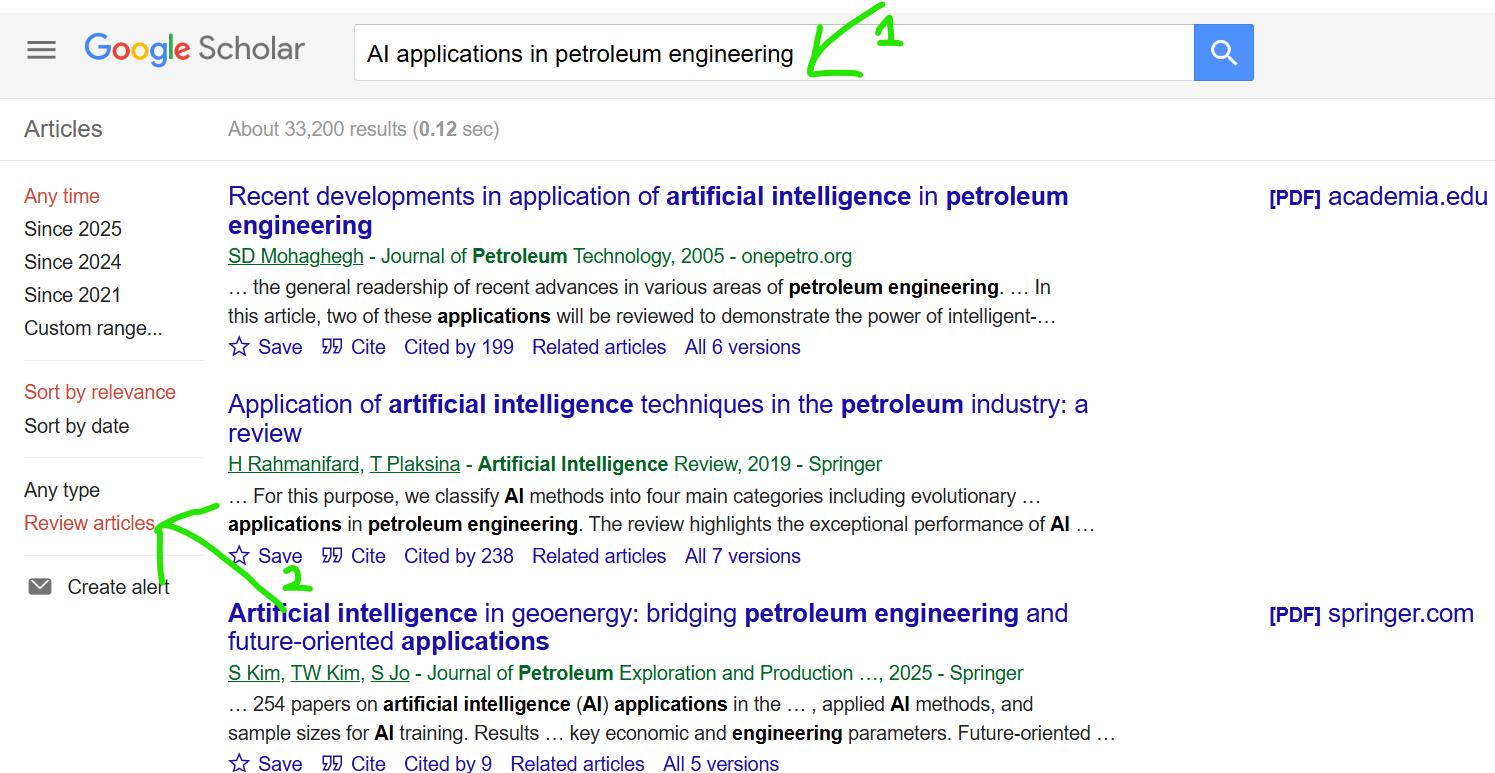
I also suggest you get the most recent articles when doing your research. After you have gotten a holistic view of your niche by reading the review articles, you will be able to identify some research gaps, which we are going to discuss next.
4. Identify Research Gaps
A research gap is the problem you are trying to solve through research. For you to identify these gaps, you must have a holistic view of your research niche and ask yourself the following questions:
What has already been studied about this niche, and what remains unexplored or unclear?
For example, many studies have applied machine learning models to predict oil production rates, but fewer have explored how these models perform under varying geological conditions, such as fractured reservoirs. This unexplored area presents a clear research gap.
Are there contradictions or inconsistencies among existing studies?
For example, some studies report that artificial neural networks outperform support vector machines in predicting permeability from well logs, while others show opposite results when training data is limited. This inconsistency suggests a need for a comparative study that clarifies which models perform best under specific data conditions.Have certain populations, regions, datasets, or conditions been overlooked?
For example, most AI-driven drilling optimization studies focus on offshore wells, while onshore and geothermal wells receive much less attention. Investigating these neglected contexts could fill a valuable research gap.Are current methods or models limited, outdated, or insufficient?
For example, traditional decline curve analysis methods are still widely used for production forecasting, but they often fail to capture nonlinear reservoir behaviors. This limitation creates room for developing hybrid machine learning models that combine physics-based and data-driven approaches for improved accuracy.Can existing theories or findings be extended, improved, or applied in a new way?
For example, techniques like convolutional neural networks (CNNs), commonly used for image analysis, could be adapted to interpret core sample images or seismic data for automated lithology classification. Applying these models in a new petroleum engineering context defines a clear and innovative research gap.
When choosing a research gap, ensure it is relevant, feasible, and original as discussed earlier.
5. Convert Your Research Gap into a Research Topic
Now that you have broadly read and identified a research gap in your niche, you need to refine the gap into a focused research problem, then into a focused research topic. Let’s say, for instance, you have observed that most AI-driven drilling optimization studies emphasize offshore wells, while onshore and geothermal wells receive far less attention. You might write the gap as: “Limited application and validation of AI-driven drilling optimization models in onshore and geothermal wells.”
Next, you need to narrow down the scope so your research becomes focused and achievable. The gap you identified is broad because you cannot study every kind of onshore or geothermal well, nor every existing AI technique. So, you might decide to focus on a specific AI approach (such as traditional ML, neural networks, or hybrid models) and a particular operational aspect (such as rate of penetration, torque prediction, or lithology classification). For example, you could narrow it to: “The lack of reinforcement learning applications for real-time ROP optimization in geothermal drilling.” This refinement makes the study practical and focused on a measurable goal.
Finally, you can refine your research gap into a clear and concise topic statement. Note that a strong topic statement combines your research focus, method, and context in one line. Based on the example, you could form topics such as:
“Application of Reinforcement Learning for Drilling Optimization in Geothermal Wells”
“Reinforcement Learning-Based Real-Time Optimization of Rate of Penetration (ROP) in Geothermal Drilling”
Conclusion
Finding a good research topic is not just about picking an interesting idea; it is about identifying a meaningful, feasible, and original problem that drives your curiosity and adds value to your field. The process begins with understanding your passion, reading widely to gain a holistic view of your research niche, and asking the right questions to uncover gaps in existing knowledge. Once you identify a gap, refining it into a focused and actionable topic ensures your study remains achievable and impactful. Remember that research is a journey of learning, not just a task to complete. The more intentional you are about choosing your topic, the more likely you are to stay motivated, produce quality work, and contribute something truly significant to your discipline.
About the author
Hi 🙋♂️ I am Franklin Obika, a reservoir engineer and data scientist passionate about solving oil and gas challenges using Excel, data analytics, and machine learning. Beyond my technical skills, I am recognized as a valuable team member, always eager to collaborate, share knowledge, and contribute to a dynamic work environment. I am committed to continuous learning and always seek new challenges where I can apply my skills to make a meaningful difference. Let's connect if you are exploring opportunities in AI, machine learning, or Excel, or if you are interested in collaborating on impactful research projects! 😊🤝
Comments
Join the discussionNo comments yet. Be the first to comment.